
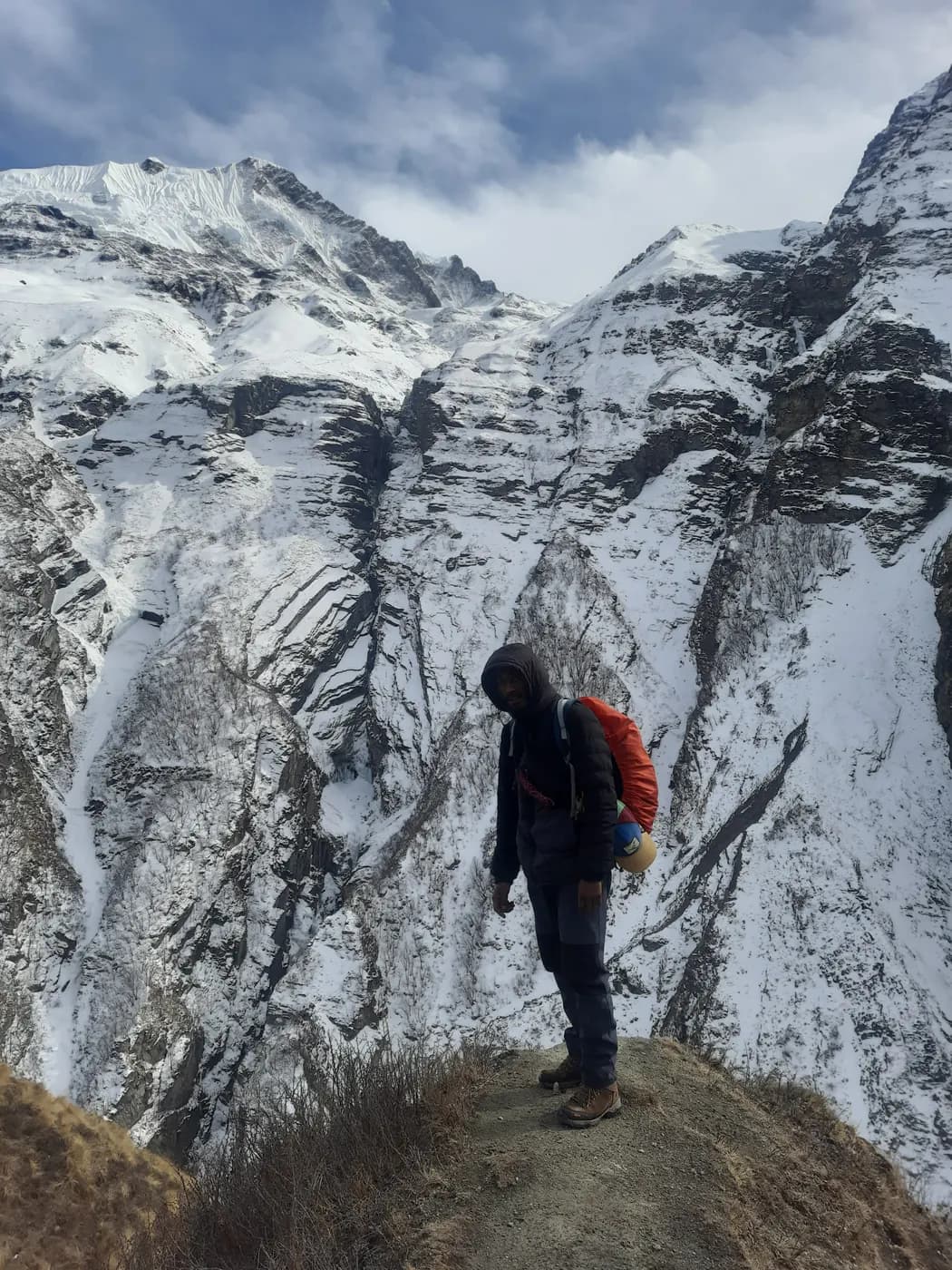
Altitude on the Annapurna Circuit: the risk is real
On this trek you sleep from about 1,300 m at Jagat up to 4,800 m at Thorong High Camp, and you cross Thorong La at 5,416 m. At the top of the pass there is roughly half the oxygen available at sea level.
Altitude illness becomes possible above about 2,500 m and becomes a genuine planning concern above 3,500 m. On the Circuit that means the stretch from Manang to Thorong La is the high-risk section, and it is where our itineraries slow down rather than speed up.
Two things are worth understanding before you read anything else:
- Fitness does not protect you. Altitude illness is not a fitness problem. Marathon runners get AMS; unfit walkers sometimes sail through. Being strong lets you climb faster, which is the opposite of what helps.
- Ascent rate is what matters. How fast you go up, and how high you sleep, determines your risk far more than how far you walk.
What is altitude sickness?
As you go higher, air pressure falls, so each breath delivers less oxygen. Your body compensates: faster breathing, higher heart rate, more red blood cells over time. Acclimatisation is that adjustment, and it takes days, not hours. Altitude illness is what happens when you climb faster than your body adapts.
It takes three forms, on a spectrum from common and manageable to rare and fatal:
| AMS Acute Mountain Sickness | Common. Headache plus nausea, tiredness, poor appetite or bad sleep. Unpleasant, usually resolves with rest at the same altitude. The warning sign, not the emergency. |
|---|---|
| HAPE High Altitude Pulmonary Oedema | Rare and dangerous. Fluid in the lungs. Breathlessness at rest, a cough that may become frothy, extreme fatigue. Needs immediate descent. |
| HACE High Altitude Cerebral Oedema | Rare and life-threatening. Swelling of the brain. Confusion, loss of coordination, drowsiness. Needs immediate descent. |
Most trekkers on the Circuit feel some mild AMS symptoms at some point. Very few develop HAPE or HACE, and almost all who do had warning signs first that were pushed through rather than acted on.
AMS symptoms: recognise them early
The internationally used measure is the Lake Louise Acute Mountain Sickness score. It begins with a headache at altitude, then grades four things:
- Headache: from mild to severe and incapacitating
- Gastrointestinal symptoms: poor appetite, nausea, vomiting
- Fatigue or weakness: beyond what the day's walking explains
- Dizziness or light-headedness
Disturbed sleep and breathlessness on exertion are also typical. The signs that move this from "uncomfortable" to "get down now" are breathlessness at rest, loss of coordination, and confusion or unusual behaviour.
Tell your guide. Trekkers hide symptoms because they have paid, flown a long way, and do not want to be the person who stops the group. Our guides ask every evening for exactly that reason. Nobody has ever been thought weak for reporting a headache; people have died from not mentioning one.
The Manang acclimatisation rule
Every itinerary we sell builds a real acclimatisation stage into the Manang valley. On the 8-day Circuit that is a full rest day at Manang (3,540 m), not a half day and not an optional extra, and we cut low-altitude road-walking days instead. On the Tilicho and lakes versions the acclimatisation is done by walking high and sleeping low rather than by sitting still.
It works on the principle of climb high, sleep low. The rest day is not spent lying in a teahouse: you walk several hundred metres higher during the day, towards Ice Lake, the Gangapurna viewpoint or Praken Gompa, and come back down to sleep. Your body gets the stimulus of altitude without having to sleep in it.
The high route from Upper Pisang over Ghyaru (3,730 m) and Ngawal (3,660 m)that we take on the way to Manang does the same job a day earlier: you touch 3,730 m and sleep at 3,540 m.
If you are offered an Annapurna Circuit itinerary with no Manang rest day, that is not a bargain. It is the acclimatisation being removed to fit a shorter brochure.
The ascent profile: where this trek gets serious
Sleeping altitudes on our 8-day Circuit:
| Chame | 2,670 m |
| Upper Pisang | 3,300 m |
| Manang, plus a full acclimatisation day | 3,540 m |
| Yak Kharka | 4,050 m |
| Thorong Phedi / High Camp | 4,450 m / 4,880 m |
| Thorong La, crossed, not slept at | 5,416 m |
| Muktinath | 3,760 m |
Read that table and two things stand out. First, the gains above Manang are deliberately small, roughly 500 m and 400 m, because that is the accepted guidance for sleeping altitude above 3,000 m. Second, pass day is the aggressive one: from High Camp you gain around 600 m to the pass and then descend more than 1,600 m to Muktinath in a single day.
That descent is the saving grace of this route. Whatever the pass does to you, you finish the day far lower than you started, which is the most effective treatment there is. See the route map for the full profile.
Diamox (acetazolamide): should you take it?
Acetazolamide, sold as Diamox, is the drug most commonly used to help prevent AMS. It works by mildly acidifying the blood, which stimulates breathing and speeds acclimatisation. It is genuinely useful, and it is not a licence to climb faster.
In the UK it is a prescription medicine, and for altitude prophylaxis it is usually prescribed off-label. Get it from your GP or a travel clinic, and do it several weeks before you fly rather than in the last few days.
Points worth raising with the prescriber:
- Dosage is their call, not ours. We deliberately do not publish a dose on this page. It depends on you, and it is a clinician's decision.
- Common side effects include tingling in the fingers and toes, increased urination, and fizzy-tasting carbonated drinks. They are harmless but surprising if unexpected.
- It is a sulfonamide, so flag any sulfa allergy.
- Try a trial dose at home before the trek, so you learn how it affects you somewhere safe.
- It increases fluid loss, so it needs to be paired with drinking more.
What to do if symptoms start
- Tell your guide. Immediately, not at dinner.
- Stop ascending. Do not sleep higher than the night before until symptoms have gone.
- Rest, hydrate, eat. Mild AMS very often resolves with a day at the same altitude.
- If symptoms worsen, or do not improve, descend. Even 500 m makes a large difference, and the improvement is usually quick.
- Never descend alone, and never let anyone with symptoms walk down unaccompanied.
Our guides carry a pulse oximeter and take readings at the higher camps, and carry supplementary oxygen above Manang. An oximeter reading is a data point, not a verdict: how you look and behave matters more than the number.
Your guide has the authority to order a descent, and that decision is final. It is written into our booking terms deliberately, so nobody is negotiating safety at 4,800 m.
HAPE and HACE: the emergencies
These are the rare outcomes that make everything above worth taking seriously.
| Suspect HAPE if | Breathless at rest, persistent cough, tightness in the chest, extreme fatigue, blue-tinged lips |
|---|---|
| Suspect HACE if | Confusion, unusual behaviour, severe headache unrelieved by painkillers, unable to walk a straight line, drowsiness |
| Treatment for both | Immediate descent, oxygen, and evacuation. Descent is the treatment; everything else buys time. |
A simple field test for HACE is the heel-to-toe walk: if someone cannot walk a straight line heel-to-toe, treat it as HACE and get them down.
Emergency medications for these conditions exist and are carried on serious expeditions, but they are prescription drugs whose use is a clinical decision: they buy time for descent; they do not replace it. If evacuation is needed, helicopter rescue is the realistic option above Manang, and it is expensive. This is precisely why your insurance must cover trekking to 6,000 m and helicopter evacuation, as our permits and paperwork page sets out.
Pre-existing conditions
Talk to your GP before booking, not after, if you have any of the following: heart disease, high blood pressure, asthma or other lung disease, diabetes, epilepsy, sickle cell disease, a clotting disorder, sleep apnoea, or if you are pregnant. Recent surgery and recent respiratory infection also matter.
Very few of these rule out the Circuit outright. Most need a conversation, a medication review and sometimes a slower itinerary such as our 11-day lakes route. Tell us too. It is on the health declaration in our terms, and your guide can only help with what they know about.
Our altitude-safety protocol
- A full acclimatisation day at Manang on every itinerary, without exception
- The Ghyaru–Ngawal high route for climb-high-sleep-low before Manang
- Modest sleeping-altitude gains above 3,000 m
- Evening symptom checks and pulse oximetry at the high camps
- Supplementary oxygen carried above Manang
- Guides with the authority to turn any trekker, or the whole group, around
- Insurance checked before departure, not after an incident
- A weather call on Thorong La that we are prepared to lose money on
