The quick answer: when to trek the Annapurna Circuit
The best time to trek the Annapurna Circuit is October and November, followed closely by mid-March to early May. Those two windows give you the most settled weather, the clearest views of the Annapurna and Manaslu ranges, and the highest chance of crossing Thorong La (5,416 m) without drama.
We do not run the circuit during the monsoon (June to mid-September), and we are cautious about mid-winter (December to February), when the pass is frequently blocked by snow and the High Camp lodges may be shut. Those are not marketing positions. They are what the trail actually does.
If you only remember one sentence from this page: the circuit is not a pass crossing with a walk attached. It is a commitment of eight to eleven days whose one irreversible day sits at 5,416 m. Choose the month that gives that day the best odds, and everything else on the trek follows.
| Best overall | Mid-October to late November |
|---|---|
| Best for flowers and warmth | Late March to early May |
| Quietest trails with the pass usually open | Early March · early December |
| Hardest but emptiest | January and February: experienced parties only |
| We do not run it | Mid-June to mid-September (monsoon) |
| Clearest mountain views | Late October and November |
| Warmest nights at altitude | Late April and May |
Annapurna Circuit seasons at a glance
Four seasons, four completely different treks. The table below is the short version; the sections beneath it explain what each one is like to walk.
| Season | Months | Weather | Crowds | Thorong La | Verdict |
|---|---|---|---|---|---|
| Autumn | Late Sep – Nov | Dry, stable, cold nights, exceptional visibility | Busiest of the year | Most reliable window | Best. Book early |
| Spring | Mid-Mar – mid-May | Warming, longer days, hazier afternoons | Busy but less so than October | Normally open from mid-March | Excellent, and prettier low down |
| Winter | Dec – Feb | Cold and clear low down; severe at the pass | Very quiet | Frequently impassable | Experienced parties only |
| Monsoon | Mid-Jun – mid-Sep | Wet, cloudy, landslide-prone below Manang | Almost empty | Crossable in dry spells, but the approach is the problem | We do not run it |
Notice that the pass column and the weather column do not tell the same story. Thorong La is often crossable in months when the rest of the circuit is miserable, and occasionally shut in the middle of a perfect autumn week. The pass is one day; the trek is fourteen. Plan for both.
Autumn (October and November): the peak season
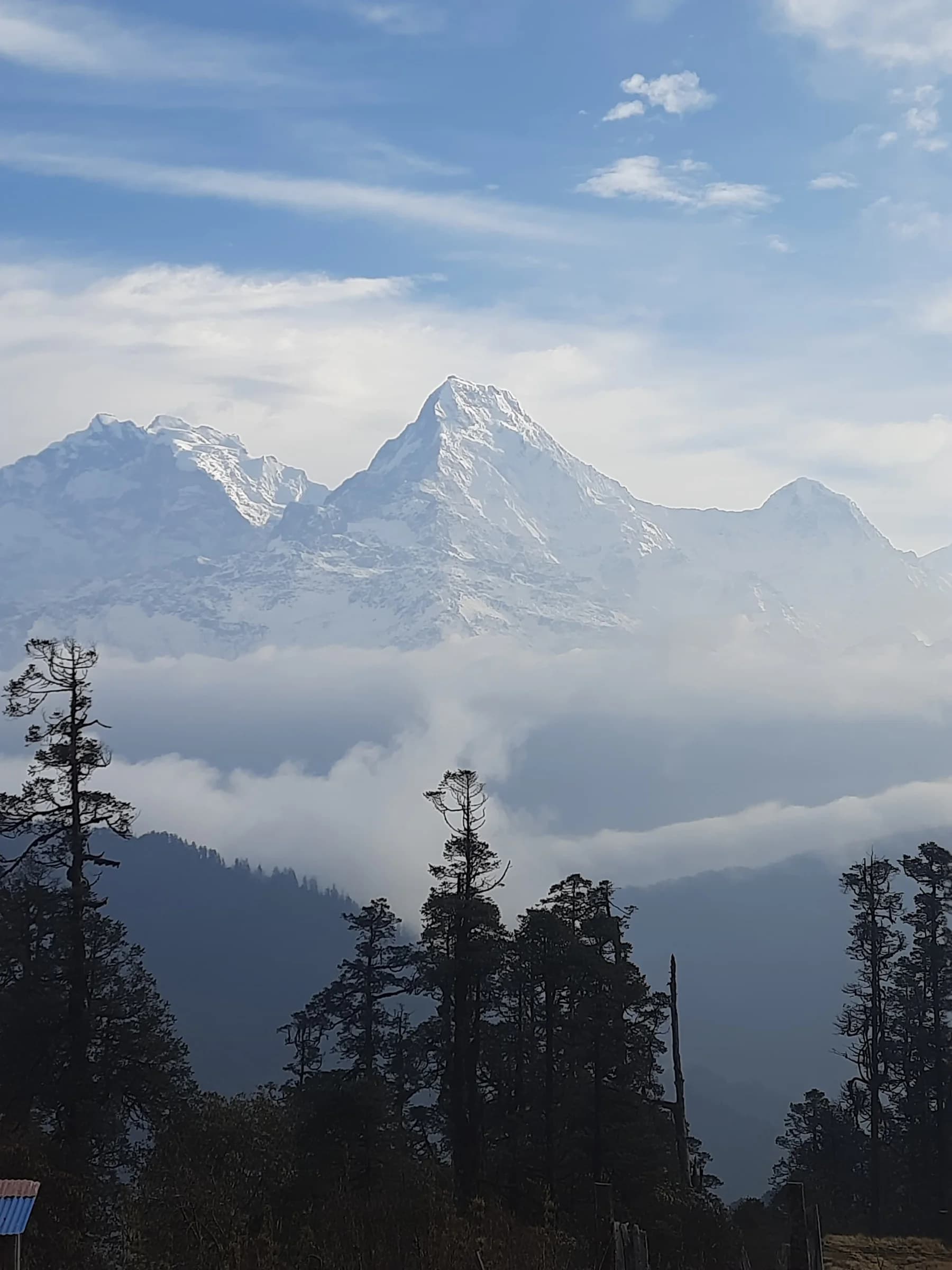
Autumn is the season the Annapurna Circuit was built for. The monsoon retreats through late September, taking the cloud and the dust with it, and what is left is weeks of dry, stable, startlingly clear weather. Fields in the Marsyangdi valley are gold with ripening millet, the air above Manang is so transparent that Gangapurna looks close enough to touch, and the pass sits under blue sky morning after morning.
Octoberis the most popular month of the Nepali trekking year. Daytime walking is comfortable: shirt-sleeves at Jagat and Dharapani, a fleece by Chame, a proper jacket at Manang. Nights are cold above 3,000 m and genuinely cold at Yak Kharka and High Camp. Dashain and Tihar, the two big Nepali festivals, fall somewhere in October or early November depending on the lunar calendar, which means villages are lively and some road transport is busier than usual.
November is our own favourite. The trail thins out noticeably after the first week, visibility is at its absolute best, and the light in the Kali Gandaki in the second half of the month is worth the trip on its own. The trade-off is temperature: by late November the dawn on Thorong La is regularly between −10 °C and −20 °C before wind chill, and the lodges at High Camp are unheated apart from the dining room. Late-November trekkers need every layer on our packing list and then a proper down jacket on top.
What autumn costs you
Two things. First, company: mid-October on the section between Manang and Muktinath is the busiest stretch of trail in the Annapurna region, and the beds at Thorong Phedi and High Camp genuinely sell out. We book those ahead; independent trekkers arriving late in the afternoon sometimes do not get one. Second, flight prices: October and November are peak for UK–Kathmandu routings, so a February booking for an October departure typically saves £150–£250 against booking in August. The cost page has the full budget picture.
Spring (mid-March to mid-May): the second peak
Spring is autumn's quieter, warmer, greener cousin, and for a lot of UK trekkers it is the better fit. Days lengthen, the lower valley turns from brown to green, and from late March through April the rhododendron forest between Bahundanda and Chame flowers in sequence up the hillside: reds low down, pinks and whites higher. It is the single prettiest thing on the lower circuit and autumn trekkers never see it.
Mid-March is a transitional fortnight. Winter snow can still be lying on Thorong La in the first ten days of the month, the High Camp lodges reopen gradually rather than on a fixed date, and the crossing is a judgement call made at Phedi. From roughly the third week of March the pass is normally in condition and stays that way.
April is the strongest spring month: reliably open pass, warm walking below 3,000 m, comfortable nights at Manang, and long enough daylight that the crossing day feels less compressed. Early Mayis still good, and it is the warmest the high sections ever get: dawn at the pass often only around −5 °C to −10 °C.
The haze problem, stated plainly
Spring's weakness is visibility. As the plains heat up through April and May, dust and agricultural haze drift north and sit in the valleys. Mornings are usually clear, but by early afternoon the far peaks often soften into a milky white. If your priority is photography of the Annapurnas, autumn beats spring and it is not close. If your priority is comfortable walking, flowers and fewer people, spring wins.
By mid-May the pre-monsoon builds: afternoon cloud, occasional thunderstorms in the lower valley, and increasing humidity. It is still walkable, but the trend is the wrong way and we would rather move you to April.
Winter (December to February): possible, and not for everyone
Winter on the Annapurna Circuit is a genuinely beautiful and genuinely serious proposition, and the two facts are inseparable.
The good part: the air in December and January is the driest of the year, the mountain views on a clear morning are extraordinary, and the trail is nearly empty. Teahouses that turn people away in October will give you the best room in the building and light the stove for you alone. Lower and middle sections, Besisahar to Manang, stay walkable through most winters.
The hard part is the pass and the top of the route. Thorong La is frequently impassable from late December through February, sometimes for a fortnight at a time after a snowfall, and there is no authority that opens or closes it: whether it can be crossed on a given morning is a judgement made by guides and lodge keepers at Phedi. Some of the High Camp and Thorong Phedi lodges close for the season, which removes the option of a short pass day. Dawn temperatures at the pass in January can sit between −20 °C and −30 °C before wind chill, and daylight is at its shortest, which matters on a day that already starts in the dark.
Our honest position: early December is a good, underrated fortnight, cold but usually stable, with the pass normally still in condition. January and February are for experienced, properly equipped parties who accept they may not cross, and who have a plan for retracing to Chame and taking a jeep out. If the circuit is your first Himalayan trek, do not make it a winter one.
Monsoon (mid-June to mid-September): we do not run it
We would rather lose the booking than sell you a monsoon circuit, so here is why.
From mid-June the summer monsoon pushes up from the Bay of Bengal and the lower Marsyangdi valley takes the full force of it. The specific problems, in order of how much they will spoil your fortnight:
- You will not see the mountains.Cloud sits in the valleys most of the day. Trekkers routinely walk from Besisahar to Chame without a single clear view of anything above 5,000 m.
- Landslides close the road and the trail. The jeep track up the Marsyangdi is cut by slips several times each monsoon. A closure adds days, and the diversions are on foot.
- Leeches. The forest sections between Bahundanda and Dharapani are thick with them in July and August. This is an irritation rather than a danger, but it is a real one.
- Flight disruption. The Kathmandu–Pokhara hops are cancelled far more often, and Kathmandu arrivals divert.
- Wet kit that never dries. Teahouse drying rooms are limited and everything you own stays damp for a fortnight.
The one honest caveat: Manang and Mustang lie in the Annapurna rain shadow and stay comparatively dry all summer. That is why a small number of trekkers fly straight into Jomsom in July or August and walk the upper Kali Gandaki or Mustang, and why some Nepali operators genuinely do sell "monsoon Annapurna" trips. Those are a different trek from the circuit. Getting to the rain shadow means walking through the rain, and Thorong La in an August whiteout is not a place to arrive underprepared.
If your only free fortnight is in July or August, message us. We will point you at a rain-shadow itinerary or a different month rather than sell you the classic circuit and hope.
Only free in the monsoon? Ask us what actually works: 07344 063016Annapurna Circuit weather month by month
Three altitude bands, because the circuit spans 4,600 m of vertical and a single "Nepal weather" figure is useless. The lower valley band covers Besisahar to Chame (760–2,670 m); Manang is 3,540 m; the pass figure is dawn on Thorong La at 5,416 m, which is when you will be standing on it.
| Month | Lower valley, day | Manang, day / night | Thorong La, dawn | Rain or snow | Pass status | Trail |
|---|---|---|---|---|---|---|
| January | 10–16 °C | 4–8 / −12 to −18 °C | −20 to −30 °C | Occasional snow at altitude | Often blocked | Empty |
| February | 12–18 °C | 5–10 / −10 to −16 °C | −18 to −28 °C | Occasional snow at altitude | Often blocked | Empty |
| March | 16–22 °C | 8–13 / −6 to −12 °C | −12 to −20 °C | Dry, occasional late snowfall | Variable early, reliable from mid-month | Quiet, filling |
| April | 19–25 °C | 11–16 / −4 to −9 °C | −8 to −15 °C | Mostly dry, afternoon cloud | Reliably open | Busy |
| May | 21–27 °C | 13–18 / −2 to −6 °C | −5 to −12 °C | Pre-monsoon storms late in month | Open | Busy, tailing off |
| June | 21–27 °C, humid | 13–18 / 0 to −5 °C | −4 to −10 °C | Monsoon arrives mid-month | Usually open, approach unreliable | Emptying |
| July | 20–26 °C, wet | 12–17 / 1 to −4 °C | −2 to −8 °C | Heaviest rain of the year below Manang | Crossable in dry spells | Empty |
| August | 20–26 °C, wet | 12–17 / 1 to −4 °C | −2 to −8 °C | Heavy rain, landslide risk | Crossable in dry spells | Empty |
| September | 19–25 °C | 11–16 / −1 to −6 °C | −5 to −12 °C | Monsoon clears from around mid-month | Improving through the month | Filling from late month |
| October | 17–23 °C | 9–14 / −5 to −10 °C | −10 to −18 °C | Dry and settled | Most reliable of the year | Busiest |
| November | 14–20 °C | 7–12 / −8 to −14 °C | −12 to −20 °C | Dry, exceptional visibility | Reliable, cooling through month | Busy, thinning late |
| December | 11–17 °C | 5–10 / −10 to −16 °C | −16 to −25 °C | Dry, first serious snowfalls | Usually open early, closing late | Quiet |
Two things worth reading off that table. First, the lower valley is pleasant all year. The circuit is never "too cold" at Jagat. Everything that makes a month good or bad happens above Manang. Second, the difference between the best month and the worst month at the pass is about 20 °C at dawn, which is the difference between a cold walk and a cold-injury risk.
Thorong La pass-open windows
The single planning question that matters. Nobody officially opens or closes Thorong La. There is no barrier, no permit that gets withdrawn and no published closure notice. It simply becomes impassable when there is too much fresh snow on it, and passable again when the trail has been broken by people and yaks.
| Window | Typical condition | What we plan for |
|---|---|---|
| Mid-March to mid-May | Reliably crossable; residual snow early, softening later | Standard itinerary; add a buffer day |
| Late September to late November | The most reliable window of the year | Standard itinerary; add a buffer day |
| Early December and early March | Usually crossable, less predictable | Standard itinerary plus a willingness to wait a day at Phedi |
| Mid-December to February | Frequently impassable after snowfall; some lodges shut | Experienced parties only, with an agreed retreat plan |
| Mid-June to mid-September | Often crossable itself, but the approach is the problem | We do not run it |
None of our three itineraries carries a buffer day as standard, and we would rather say so than let you find out at Phedi. If the pass is not crossable on your scheduled morning you wait and go the next day, which means the day has to come from somewhere. Ask us to add one when you enquire and we will price it: on the 11-day lakes route it slots naturally into Manang. An itinerary with no buffer is quietly assuming your international flight has slack in it, so make sure yours does.
Crowds, beds and how busy each month really is
"Crowded" on the Annapurna Circuit does not mean queuing. It means the beds at two specific lodges, Thorong Phedi and Thorong High Camp, are finite, and in mid-October more people want them than there are beds. Everywhere else you will walk for long stretches without seeing anybody.
- Busiest: the first three weeks of October, then early April.
- Comfortably busy: late September, November, mid-March, late April, early May.
- Quiet with a working pass: early March, early December.
- Near-empty: January, February, and the whole monsoon.
The practical effect of booking with a guided operator in peak season is that the Phedi and High Camp beds are held for you in advance. That is not a small thing in the third week of October, and it is one of the few places where a package genuinely buys something an independent trekker cannot arrange from the trail.
If solitude matters more to you than a guaranteed crossing, look at the Tilicho Lake variant: the Tilicho Base Camp detour is far quieter than the main valley even at the height of October.
When to book from the UK
Booking lead times are driven by flights and by two lodges, not by us. We can add a departure at short notice; British Airways and Qatar cannot.
| October / November departure | Book 5–7 months ahead |
| March / April / May departure | Book 3–4 months ahead |
| Early December departure | Book 2–3 months ahead |
| January / February departure | Book 4–8 weeks ahead |
For an autumn trip, the flight is the reason to move early: booking a mid-October departure in February rather than August commonly saves £150–£250 per person on the return fare alone, which is more than the difference between our 8-day and 11-day itineraries.
Fitting the circuit into UK leave
This is the awkward bit and worth saying plainly. Our itineraries are quoted Pokhara to Pokhara, so the number on the page is not the number of days you book off work. Add roughly two travel days each end from a UK airport, plus a day each way between Kathmandu and Pokhara. Realistic options:
- Two weeks: the 8-day Circuit, about 13 to 14 days door to door. It fits, with almost nothing spare, which is the argument for adding a buffer day.
- Two weeks plus a few days: the 10-day Tilicho route, about 15 to 16 days door to door, and a much better altitude profile for the extra leave.
- Three weeks of leave: the 11-day lakes route with a buffer day, which is the comfortable version and the one we would take ourselves.
- Easter: the two-week Easter break plus a few days is the neatest spring fit, and lands in the best fortnight of April.
How hard the walking actually is, and whether your current hill fitness is enough, is covered on the difficulty and fitness guide. What the whole trip costs from the UK is on the cost page.
Best time to trek the Annapurna Circuit: FAQ
What is the best time to trek the Annapurna Circuit?
Can you trek the Annapurna Circuit in November?
Is March a good month for the Annapurna Circuit?
Can you trek the Annapurna Circuit in the monsoon?
Is the Annapurna Circuit possible in winter?
How far ahead should I book from the UK?
Which month has the best mountain views?
Does the pass ever close in the main season?