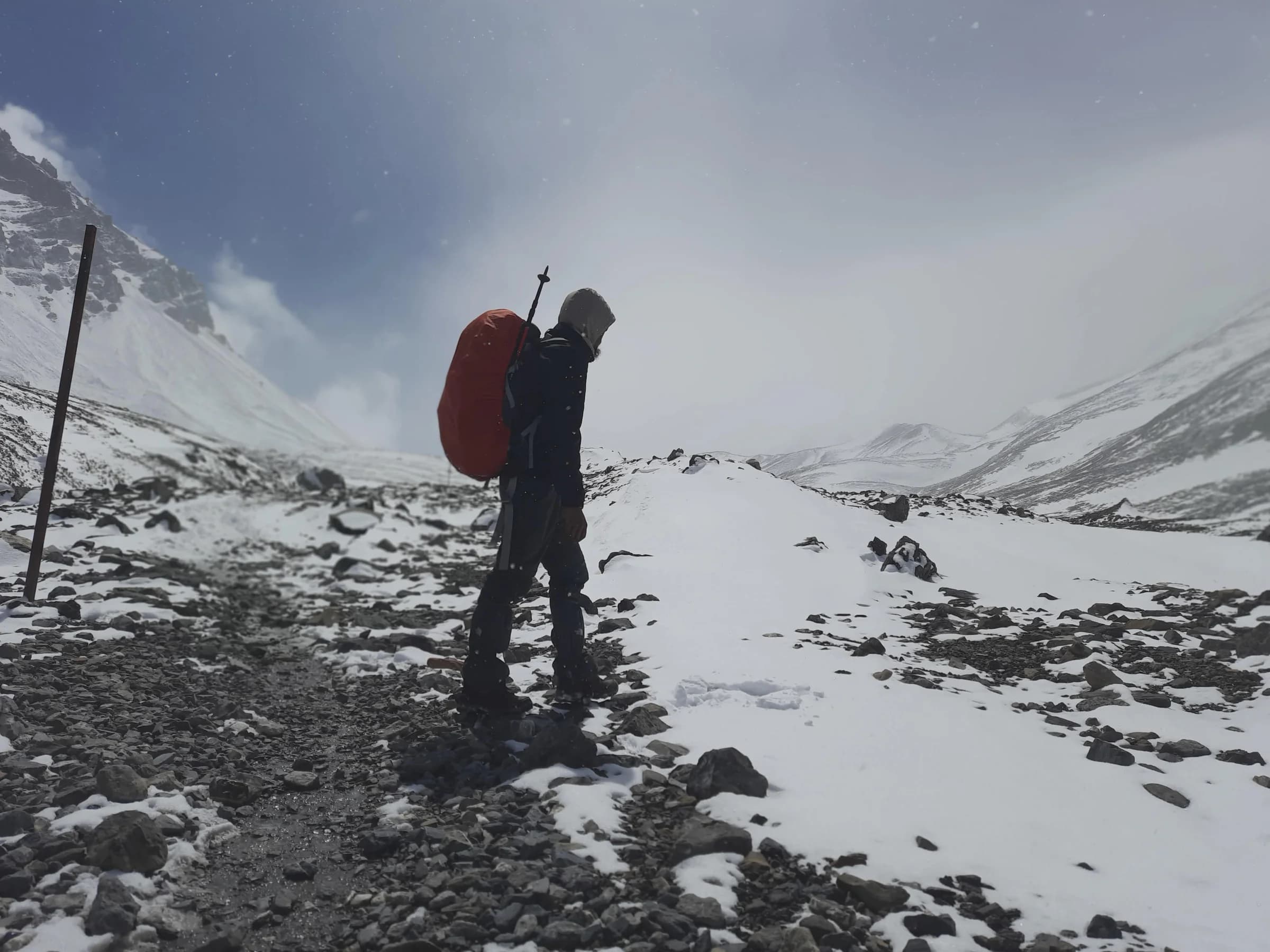
The trek & the route
What is the Annapurna Circuit trek?
The Annapurna Circuit is a lodge-based trek that loops around the Annapurna massif in central Nepal. You walk up the Marsyangdi valley on the green southern side, cross
Thorong La pass at 5,416 m, and descend into the dry, rain-shadowed Kali Gandaki valley past Muktinath and Jomsom. It is normally run as an 8 to 21 day trip depending on how much of the road section you walk and which side trips you add.
See the trek overview →How long does the Annapurna Circuit take?
Our standard trip is
8 days Pokhara to Pokhara, jeeping to Chame and walking from there. We also run a
10-day version with the Tilicho Lake detour and an
11-day lakes route. Add roughly two travel days each end from the UK, plus a day each way between Kathmandu and Pokhara, so the 8-day trek is about 13 to 14 days door to door.
How many km is the Annapurna Circuit?
Between roughly
160 km and 230 km, depending on where you start walking and where you finish. Road building in the Marsyangdi and Kali Gandaki valleys means most trekkers now jeep past some of the lower sections, which shortens the walked distance. Our 8-day plan walks around 105 km, starting at Chame. Daily distances are on the
route map.
What is the highest point on the Annapurna Circuit?
Thorong La pass at 5,416 m. It is the only point above 5,000 m on the whole route. The highest place you
sleep is High Camp at about 4,880 m, or Thorong Phedi at about 4,450 m if conditions favour the lower option. Full detail in our
Thorong La guide.
Do you have to cross Thorong La?
To complete the full circuit, yes: Thorong La is the only connection between the Marsyangdi and Kali Gandaki sides. If the pass is closed by snow or a trekker is unwell, the alternatives are to turn back down the Marsyangdi valley, or to fly or drive around via Pokhara and Jomsom. None of our three itineraries carries a buffer day as standard, so if your flight home is fixed, ask us to add one when you enquire.
Can you do the Annapurna Circuit in 10 days?
Yes. Our
10-day Circuit jeeps to Chame and adds the Tilicho Lake detour, which does the acclimatising. Our shortest is the
8-day Circuit, which keeps a full acclimatisation day at Manang. We will not go below that: an itinerary that reaches Thorong La with no acclimatisation stage is not a shorter trek, it is a worse one.
Difficulty & fitness
Is the Annapurna Circuit trek easy?
No. It is a moderate to hardtrek. There is no technical climbing, no ropes and no glacier travel, but you walk 5 to 7 hours a day for around two weeks, and the Thorong La crossing day is a long, cold ascent to 5,416 m starting before dawn. Fit hillwalkers complete it every season; unprepared trekkers struggle.
How hard is the Annapurna Circuit?
The difficulty sits in three places: the sustained daily walking over 6 to 9 days, the altitude above Manang, and the pass day. Thorong La day is typically 7 to 9 hours of walking with about 1,000 m of ascent and 1,600 m of descent, at altitudes where you are working on roughly half the oxygen you get at sea level. See our
difficulty and fitness guide.
Am I fit enough for the Annapurna Circuit?
A useful test: can you walk 6 to 7 hours on hilly UK ground carrying a daypack, on consecutive days, and feel ready to do it again the next morning? If yes, you have the base fitness. Altitude tolerance is separate from fitness and cannot be trained at sea level, which is why our itinerary builds in an acclimatisation day at Manang.
Which is harder, the Annapurna Circuit or Kilimanjaro?
They are hard in different ways. Kilimanjaro is higher at 5,895 m and gains altitude much faster over 6 to 9 days, so the acute altitude risk is greater. The Circuit is longer and more sustained, with two weeks of daily walking, but the ascent profile is far gentler. Most people find Kilimanjaro harder on the body over a short window and the Circuit harder as an endurance trip.
Full comparison →Which is harder, the Annapurna Circuit or Everest Base Camp?
Everest Base Camp sleeps higher for longer, reaching 5,364 m with several nights above 4,000 m, so its cumulative altitude load is greater. The Circuit has the single higher point at 5,416 m but only touches it for an hour. The Circuit is longer; EBC is higher for longer. Neither is a beginner trek.
Compare them →Cost & booking
How much does the Annapurna Circuit cost?
Our 8-day Annapurna Circuit starts
from £660 per person on the standard tier, or £550 on the backpacker tier, booked direct with us as the Nepal operator, with no UK agency margin on top. That is an all-inclusive trek price. International flights, insurance and your Nepal visa are extra.
Full cost breakdown →What is included in the package price?
On the standard tier: vehicle transfers from Pokhara to the trailhead at Chame and the jeep back from Muktinath, private for a solo, couple or private booking and shared on a group departure, a licensed English-speaking guide, a shared porter at one per two trekkers, all teahouse accommodation on the trail, three meals a day while trekking plus tea or coffee twice daily, ACAP and TIMS permits, crew insurance, wages and lodging, and a group first-aid kit with a pulse oximeter.
What is excluded from the package price?
International flights to Kathmandu, the Nepal visa, hotels and meals in Kathmandu and Pokhara, travel and medical insurance covering trekking to 6,000 m and helicopter evacuation, drinks, hot showers, Wi-Fi and charging on the trail, personal kit, and tips for your guide and porter.
Is it safe to pay a Nepal-based operator from the UK?
You only send 25% up front. The deposit is processed through our brand hub 6knepaltreks.com and the remaining 75% is paid in Nepal, in person, before the trek starts. Our lead guide's Government of Nepal licence number is
#1497 and can be checked against the national guide register, and our guiding team is rated 4.9 from 90+
Google reviews.
How do I book?
Message us on WhatsApp or send the
enquiry form with your rough dates and group size. We reply within an hour with a tailored quote at a fixed GBP price. To hold your dates you pay a 25% deposit through 6knepaltreks.com; the balance is paid in Nepal before you start walking.
What is the deposit, and can I cancel?
The deposit is
25%. Cancel 30 or more days before departure and it is refunded in full. Between 14 and 29 days, half the deposit is refunded. Inside 14 days the deposit is forfeited, but no balance is due, because the balance is only ever paid in Nepal. You can move your dates free of charge more than 14 days out, and we hold the deposit for 24 months.
Full cancellation terms →Best time & weather
When is the best time to trek the Annapurna Circuit?
Autumn, from late September to mid-November, is the most reliable window: stable weather, clear air after the monsoon, and a Thorong La that is usually snow-free. Spring, March to May, is the second choice, warmer and greener but hazier. Those two seasons account for the large majority of successful crossings.
Month-by-month guide → Is October a good time?
October is the single most popular month and, on the weather, the best. The trade-off is crowding: teahouses in Manang and at Thorong Phedi fill up and beds have to be secured early in the day. It is also worth remembering that Nepal's worst trekking disaster, the October 2014 blizzard, happened in this month. Good average weather is not the same as guaranteed weather.
Can you trek the Annapurna Circuit in winter?
December and January crossings are possible but conditions-dependent. Thorong La can close for days at a time after snowfall, several high teahouses shut, and overnight temperatures at High Camp fall well below −15 °C. We run winter Circuit departures only as private trips with a high-altitude guide, proper kit, and a genuine willingness to abandon the pass.
Is the Annapurna Circuit open in monsoon?
The trail is open from June to August but we do not recommend it and we do not sell scheduled departures then. Views are lost to cloud, the lower Marsyangdi valley is leech-heavy, and landslides regularly close the access roads. The Mustang side beyond the pass sits in the rain shadow and stays drier, which is why some trekkers walk that half only.
Permits & paperwork
What permits do I need for the Annapurna Circuit?
Two: the
Annapurna Conservation Area Permit (ACAP) and the
TIMS card. Both are included in your package price and arranged by us. Send passport scans and passport photographs a couple of weeks before you fly. If your itinerary detours into Nar-Phu, that area needs an additional restricted-area permit.
Permits explained →Do I need a guide?
Since April 2023 the Nepal Tourism Board has required foreign trekkers on TIMS routes, including the Annapurna Conservation Area, to trek with a licensed guide rather than independently. Enforcement varies by checkpoint and the rules have changed before, so check the current position before you travel. Every trip we sell includes a licensed guide regardless.
Do I need travel insurance?
Yes, and it is a condition of booking with us. Your policy must cover trekking to at least 6,000 m and helicopter evacuation. Most standard UK travel policies cap altitude cover at 2,000 to 3,000 m, which is not enough for Thorong La. We ask for your policy number and 24-hour assistance number before you start walking.
Do I need a Nepal visa?
Yes. UK citizens can get a visa on arrival at Kathmandu airport, currently USD 50 for 30 days, or apply online in advance. Your passport must be valid for at least six months from your date of arrival and have a blank page.
Safety & altitude
Is altitude sickness a risk on the Annapurna Circuit?
Yes, and it is the single biggest medical risk on this trek. Above Manang at 3,540 m most trekkers feel some effect, and acute mountain sickness is common. Our itineraries limit sleeping-altitude gain, include a full acclimatisation day at Manang, and monitor oxygen saturation morning and evening above 3,500 m.
Altitude sickness guide →How dangerous is Thorong La?
Thorong La is not technically difficult. It is a walking pass with no ropes or climbing. It is dangerous because of altitude, weather and exposure. At 5,416 m there is roughly half the oxygen of sea level, there is no shelter for several hours in either direction, and a storm on the pass turns a straightforward day into a serious one very quickly.
Has anyone died on Thorong La?
Yes. In October 2014 an unseasonal blizzard driven by the remnants of Cyclone Hudhud caught trekkers on and around Thorong La;
more than 40 people died across the Annapurna region in what remains Nepal's worst trekking disaster. Deaths from altitude illness and exposure still occur in most seasons. We do not publish an annual figure because no reliable, verifiable one exists. See our
editorial policy on why we would rather say that than guess.
What happens if I get sick on the trail?
Your guide assesses the symptoms and, if altitude illness is suspected, the response is descent, immediately and with a guide, not overnight observation. On the Marsyangdi side there are health posts at Chame and Manang, including the Himalayan Rescue Association aid post at Manang in season. For serious cases we arrange helicopter evacuation, which is what your insurance is for.
Do you carry oxygen?
We carry a pulse oximeter and a comprehensive group first-aid kit on every departure, and supplementary oxygen on the high section around Thorong La. Oxygen is an emergency measure to buy time during a descent, never a reason to continue climbing. The treatment for altitude illness is going down.
Teahouses & food
Where do you sleep on the Annapurna Circuit?
In teahouses, family-run mountain lodges with twin rooms and, lower down, private bathrooms. The Marsyangdi valley lodges through Chame and Manang are comfortable, some with heated dining rooms and decent coffee. Thorong Phedi and High Camp are basic: unheated rooms, shared bathrooms, no reliable hot water.
What is the food like?
Teahouse menus are substantial and largely standardised: dal bhat, noodles, pasta, momos, fried rice, porridge, eggs and endless tea. Dal bhat is the one dish that comes with free refills, which is why guides eat it. Vegetarian and vegan food is available everywhere. Prices rise the higher you go, because everything is carried or muled up.
Are there hot showers?
Usually, for a small fee, up to about Manang. Above that they become unreliable, and at Thorong Phedi and High Camp there are none. Expect to pay NPR 300 to 600 per shower higher up, and to skip washing for the two days either side of the pass.
Is there Wi-Fi and phone signal?
Ncell and NTC mobile coverage reaches most villages up to Manang and again from Muktinath down, with dead zones in between and nothing reliable at the pass. Teahouse Wi-Fi is widely sold but slow, and often fails when the lodge is full. Buy a local SIM in Kathmandu or Pokhara and bring a power bank.
Kit & packing
What should I pack?
Layers, because you will walk in a t-shirt at 2,000 m and in a down jacket at 5,416 m on the same trip. Base layers, a fleece, an insulated jacket, a waterproof shell, warm hat and two pairs of gloves, broken-in boots, trekking poles, sunglasses and high-factor sun cream for the snow, a 30 to 40 litre daypack and a 4-season sleeping bag.
Full packing list →Can I hire gear in Nepal?
Yes. Kathmandu and Pokhara have dozens of rental shops. Down jackets, sleeping bags, trekking poles and duffels rent for roughly £1.50 to £3 per item per day. Quality varies a lot, so hire the bulky items and bring your own boots, socks and base layers from the UK.
Do I need a sleeping bag?
Yes. Teahouses provide blankets but they are not enough at High Camp, where the room temperature can drop below freezing overnight. Bring or hire a bag rated to around −10 °C comfort. A silk or fleece liner adds a few degrees and keeps the bag clean.
What boots do I need?
Mid or high-cut walking boots with ankle support and a stiff-ish sole, waterproof, and thoroughly broken in before you fly. The descent from Thorong La to Muktinath drops about 1,600 m on loose ground, which is where trainers and new boots cause blisters and bruised toenails. Microspikes are worth carrying in the shoulder seasons.
Comparisons
Annapurna Circuit or Annapurna Base Camp?
They are different treks. The Circuit loops around the massif over a 5,416 m pass across two climate zones in 8 to 11 days. Annapurna Base Camp walks into a glacial amphitheatre, tops out at 4,130 m, and takes about 11 days. Base Camp is the better first Himalayan trek; the Circuit is the bigger journey. See
our Annapurna Base Camp trek, or the
side-by-side comparison.
Annapurna Circuit or Manaslu Circuit?
Both are circuits with a high pass. Manaslu crosses Larke La at 5,106 m, needs a restricted-area permit, has simpler teahouses and far fewer people. Annapurna has better lodges, more infrastructure, easier logistics and more trekkers. Choose Manaslu for solitude and Annapurna for comfort and variety,
our Manaslu Circuit trek.
Is the road ruining the Annapurna Circuit?
It has changed it rather than ruined it. Roads now reach Manang on one side and Muktinath on the other, so the classic walking route has shifted onto the
NATT trails, quieter alternative footpaths that avoid the road for most of the way. The high section either side of Thorong La is untouched and always will be. Our route uses the NATT trails wherever they exist; see the
route map.
Booking with 6K Nepal Treks
Why book direct with 6K Nepal Treks?
Because we are the company that runs the trek rather than a reseller. You pay the operator price with no UK agency margin, you can message your actual guide before you fly, and if something goes wrong on the pass you are dealing with the people delivering the trip. Our lead guide holds Government of Nepal licence
#1497.
More about us →Can you customise the itinerary?
Yes, and most of our trips are customised. We can add the
Tilicho Lake detour, collect the high lakes on the
11-day lakes route, add rest days or a buffer day in Manang, or slow the whole thing down for a group that wants more margin around the pass.
How big are the groups?
Most departures are private trips for your own group, of any size from one person upwards. Where we run a shared departure we cap it at 12 trekkers with a second assistant guide from five people. On the pass day, small groups move faster and get out of the weather sooner.
Do you look after your porters?
We cap loads at
24 kg per porter, well below the 30 kg industry norm, and we provide insulated jackets, waterproofs, boots, snow sunglasses and a sleeping bag rated to −10 °C. Porters get the same teahouse standard and the same rest days as guests, and they are insured for medical treatment and evacuation.
Our porter welfare policy →Do you run trips for solo trekkers?
Yes, solo trekkers are a large share of our bookings. You get your own licensed guide, which costs more per person than trekking as a pair, and you can either take a private departure or join a shared group to bring the price down. Solo women can ask for a female guide when they enquire.
Still have questions?
Ask us directly. There is no sales script, no deposit needed to enquire, and if the honest answer is that a different trek suits you better, we will say so.
WhatsApp us Send an enquiry